

Which Roads in Phuket Are the Most Dangerous?
The most dangerous roads in Phuket are the Patong Hill switchbacks between Kathu and Patong, the narrow road to Promthep Cape and the long straights in the north near Mai Khao. The tarmac is good almost everywhere, but these stretches have steep descents, blind bends, heavy scooter traffic and a temptation to speed. In the rainy season, fog in the hills adds to the list.
In short
- Patong Hill between Kathu and Patong: a long steep descent, blind bends, scooters overtaking on the climb.
- The road to Promthep Cape is narrow, and at sunset it fills with scooters, buses and pedestrians; keep to 40 km/h or less.
- In the north near Mai Khao the danger is speed: long straights, cameras and mobile radars.
- From May to October fog can form in the hills after a downpour, cutting visibility to a few dozen metres.
Why does Phuket have so many tricky stretches?
Phuket is hilly: the centre of the island is covered by hills up to 500 metres high, and the roads across them turn into switchbacks with sharp bends and changes in height. Lanes are narrow, bends are blind, and there is not always a crash barrier above a drop. Flat stretches such as Bypass Road are much easier.
Below are the stretches where it pays to slow down, whatever your driving experience. If you are still getting used to a right-hand-drive car, start on flat roads; tips are in the article on driving on the left.
More: SUVs. Next on this topic: Which Side Does Thailand Drive On? Left: How to Adjust. Short version in the driver guide: Thai road rules.
For mountain climbs and switchbacks take a car with power in reserve and good ground clearance.
SUVsWhat makes each stretch risky, and how do you drive it?
The surface on all four stretches is good; the risk comes from the gradient, the width of the road, the traffic and the weather.
| Stretch | Why it is risky | How to drive it |
|---|---|---|
| Patong Hill, the Kathu to Patong road | Long steep descent, blind bends, scooters overtaking on the climb | Descend in a low gear, keep 3–4 car lengths from scooters, no overtaking on bends |
| The road to Promthep Cape | Narrow; at sunset scooters on the verge, pedestrians and buses | No faster than 40 km/h, set off 1–1.5 hours before sunset |
| The north near Mai Khao and the airport approach | Long straights invite speeding; taxis near the airport change lanes abruptly | Watch the speed limit signs and your mirrors |
| The hills near Kathu and Windmill Viewpoint in the rainy season | Fog after a downpour, visibility down to a few dozen metres | Dipped headlights, at least half your usual speed, no overtaking |
What makes the Patong Hill switchbacks dangerous?
Patong Hill links Kathu with Patong and is the island's best-known switchback road. It is narrow, the climb and descent are steep, the bends are blind, and scooters overtake each other right on the climb. In the rainy season the tarmac on the descent gets slippery.
If you hold the brake pedal for long on the extended descent, the brakes overheat. Go down in a low gear, which is L or 2 on an automatic. Keep at least 3–4 car lengths from scooters and do not overtake on bends, because you can barely see the oncoming lane there.
Why is the road to Promthep Cape dangerous at sunset?
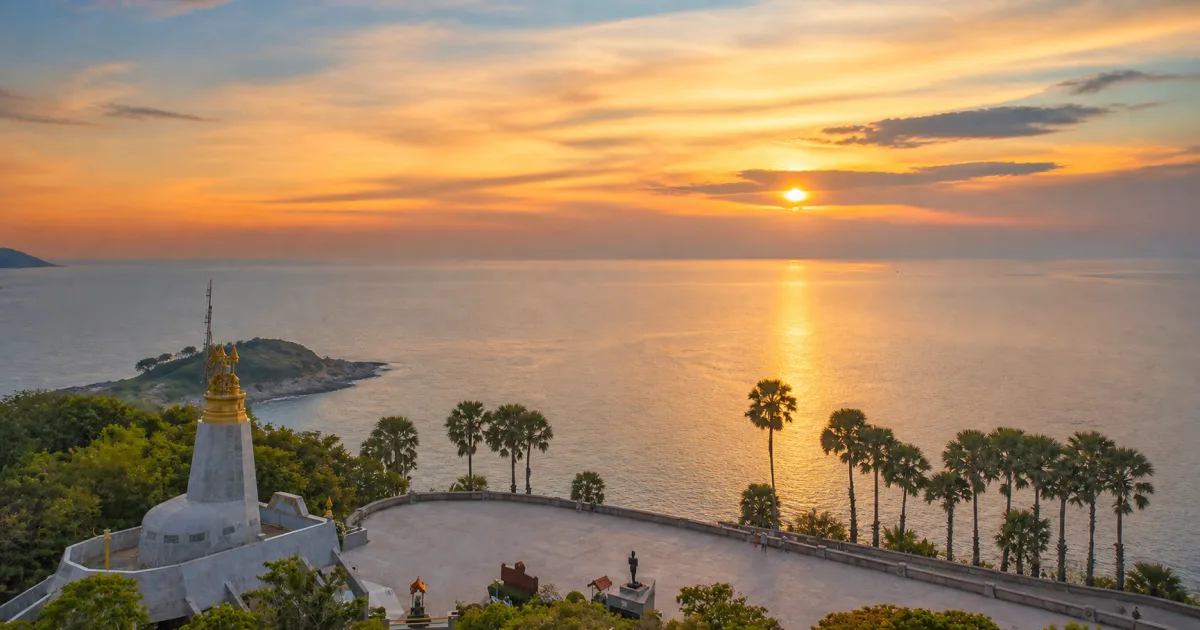
The road to Promthep Cape is narrow and winds along the coast, and in the evening hundreds of tourists drive out to watch the sunset at the same time. Scooters park right on the verge, pedestrians cross wherever they like, and tour buses take up almost the whole lane on bends.
Set off an hour to an hour and a half before sunset, ahead of the heaviest traffic, and keep to 40 km/h or less whatever the signs say. The drive back after sunset is in twilight. The southern route itself is covered in the article on where to drive in Phuket.
Where on the island do drivers speed most?
In the north, near Mai Khao and the Sarasin Bridge, the road is straight with a good surface, so drivers relax and speed up. This road has cameras and mobile radars, so keep an eye on the speed limit signs.
The second risk in the north is the approach to the airport at peak arrival and departure times. Taxis and transfer cars hurry to drop off passengers and change lanes abruptly, so keep your distance and check your mirrors more often.
What should you do in fog on hill roads?
In the rainy season, May to October, fog can form in the island's hills after a downpour: for 15–30 minutes visibility drops to a few dozen metres. It happens most often on the roads through Kathu and near Windmill Viewpoint. It does not happen every day, but it is worth being ready for.
Switch on dipped headlights or fog lights if fitted, cut your speed at least by half and do not overtake: the oncoming lane disappears from view sooner than you think. Heavy rain stops traffic on the passes for 20–30 minutes, and it is easier to wait it out in a car park.
Frequently asked questions
Is a small car fine for Phuket's hill roads?
+
Where are the calmest roads in Phuket?
+
What if the car breaks down on a hill road?
+
Does the insurance cover an accident on a switchback?
+
More on this topic: Driving in Phuket
Which Side Does Thailand Drive On? Left: How to Adjust
Thailand drives on the left. A plan for your first 30 minutes at the wheel, what is mirrored, the common early mistakes and how to handle roundabouts.
Read Thailand's road rulesParking in Phuket: Kerb Markings and Fines
What red-and-white and yellow-and-white kerbs mean in Phuket, where parking is tight, what a fine and towing cost, and who pays in a rental car.
Read PracticalPetrol Prices in Thailand in 2026: Cost per Litre
The price per litre of Gasohol 91, 95, E20 and diesel, what to put in a rental car, how to fill up at a Thai station with an attendant and what fuel costs for a day on the island.
ReadWhich area of Phuket should we deliver the car to?
Ready to book a car?
Choose a car in the catalogue: free delivery to HKT airport, basic insurance included, 24/7 support.
Go to car catalog